Showing posts with label Interest Rates. Show all posts

Monday, March 30, 2015

Chesapeake, VA Market Update...Another View


Great Recap on recent impacts on mortgage rates and the view from one of my recommended mortgage officers on the present state of the market.


Weekly Review

A decline in manufacturing activity in China coupled with a disappointing Durable Goods Orders release for February was instrumental in a declining stock market this past week.  The Commerce Department reported February's Durable Goods Orders fell 1.4%, missing expectations of a modest pick-up of 0.4%.  The Durable Goods Orders excluding transportation (aircraft), a closely watched proxy for business spending plans, fell 0.4% last month and was below the consensus estimate of 0.3%.  This was the sixth straight month of declines in Durable Goods Orders and is likely due to the combined effects of a strong dollar and weaker global demand.  January’s number was also revised lower from 2.8% to 2.0%.  This report was the latest indicator that U.S. economic growth stalled earlier this year.

In the bond market, weak demand at a couple of Treasury note auctions during the week resulted in higher yields.  Intermediate and long-term U.S. Treasury debt prices fell, pushing yields higher to end a two-week rally.  The Treasury Department brought additional supply to the bond market on Wednesday with a $35 billion five-year note auction that had a high yield of 1.387%.  The bid-to-cover ratio was 2.35 indicating weaker demand, and was the lowest bid-to-cover ratio for a five-year auction in the past four years.  Indirect bidders, which include foreign central banks, took 55.7% of the supply while direct bidders took 4.7%.  The average over the prior 12 auctions had a high yield of 1.63% and a bid-to-cover ratio of 2.66.
On Thursday, the Treasury auctioned off $29 billion in seven-year debt, but the auction drew the least demand since May 2009.  The mediocre bid-to-cover ratio was 2.32 versus an average of 2.40 over the past four auctions of similar maturity securities.  Indirect bidders took 50.5% of the supply while direct bidders took 12.3%.  The prior 12 auction average saw a bid-to-cover ratio of 2.52.  CNBC’s Rick Santelli graded the auction a “D+” and selling in the bond market accelerated to the downside following the auction.

From the week’s housing news, it appears the real estate market is on the mend.  Existing Home Sales improved by 1.2% during February to 4.88 million from an unrevised 4.82 million in January.  The consensus forecast had called for Existing Home Sales to increase to 4.90 million.  The lower than expected sales number may have been negatively impacted by severe winter weather conditions, but supply problems probably have a greater impact as inventories remain at a 4.6 month supply at the current sales rate.  A more normal inventory level is maintained at a 6.0 month supply.

The lower inventory level is pushing prices higher with the median existing home price increasing 7.5% year-over-year in February to $202,600.  February marked the 36th consecutive month of year-over-year home price increases.  Higher home prices make it more difficult for first-time home buyers to enter the market and this is evident from the 29% of February purchases made by first-time buyers.  Although this was a percent higher than January’s 28%, it is well below the 40% level that is seen under normal housing market conditions.


February New Home Sales increased to 539,000 units, annualized, surpassing analyst expectations of 465,000.  February’s sales number also exceeded January’s upwardly revised 500,000 units from the 481,000 units first reported.

Also, the Federal Housing Finance Agency reported their House Price Index increased by 0.3% in January from the previous month.  From January 2014 to January 2015, house prices were up 5.1%.  Jonathan Smoke, chief economist at realtor.com, stated “…the FHFA numbers appear to be showing a moderation in price increases which we aren’t seeing in listing prices or median existing home prices.  On the contrary, other metrics are showing acceleration in year-over-year prices that started in December and coincided when inventories started getting super tight.  The FHFA number may be weaker because it is based only on government backed purchase mortgages and therefore doesn’t reflect jumbo mortgages on higher priced homes.”


For the week, the FNMA 3.0% coupon bond lost 18.8 basis points to end at $101.94 while the 10-year Treasury yield gained 2.8 basis points to reach 1.96%.  Stocks ended the week with the NASDAQ Composite losing 135.20 points, the Dow Jones Industrial Average dropping 414.99 points, and the S&P 500 decreasing 47.08 points.

To date for 2015, and exclusive of any dividends, the NASDAQ Composite has gained 3.17%, Dow Jones Industrial Average has lost 0.62%, and the S&P 500 has gained 0.10%.  The national average 30-year mortgage rate rose to 3.79% from 3.74% while the 15-year mortgage rate increased to 3.08% from 3. 30%.  The 5/1 ARM mortgage rose to 3.16% from 3.10%.  FHA 30-year rates rose to 3.50% from 3.30% and Jumbo 30-year rates rose to 3.67% from 3.64%.

Mortgage Rate Forecast with Chart

The FNMA 3.0% coupon bond ($101.94, -18.8 bp) opened the week 9 basis points higher on Monday at $102.22 and ended up trading within a range between a weekly high of $102.63 and a low of $101.61 before settling at $101.94 on Friday.  The bond traded significantly lower on Wednesday and Thursday resulting in a new sell signal from a negative stochastic crossover.  The move dropped the bond below its intermediate lower trend line and back below the key 50-day moving average support level located at $101.99, which now becomes technical resistance.  Nearest support is now located at the 25-day moving average at $101.56.  Unfortunately, the bond remains close to “overbought” levels even with the losses on Wednesday and Thursday, and appears destined to test the next levels of support at $101.56, $101.40.  The bond did manage to bounce back a little on Friday to create a two-day Harami Japanese Candlestick candle pattern that can be a potential reversal signal, but this will require confirmation from a positive candlestick on Monday.

With the March employment report looming in the background on Friday, technical signals will likely take a backseat to economic news.  If the week’s economic news proves to be bond market friendly we should see an improvement in bond prices and lower yields.  Conversely, if the economic news is more favorable for stocks, we could see bond prices fall further to test support levels and see yields and mortgage rates rise slightly.


Chart:  FNMA 30-Year 3.0% Coupon Bond


Jim Belote NMLS # 254207   MLO #:  22270VA
Branch Manager/Senior Loan Officer
Old Point Mortgage, LLC
Branch Manager/Senior Loan Officer
1613 Laskin Road, Suite 300
Virginia Beach, VA 23451

Office:  757-690-8047 or 757-395-LOAN(5626)
Cell:  757-287-3873
eFax:     757-605-4982

Wednesday, December 17, 2014

Stock Market Willies and Real Estate

Real Estate
in an
Upset Stock Market

The stock market has almost been in a free fall in the past week.  It is kind of like it doesn't like the improving real estate sales and upbeat retail sales and related Consumer Confidence.  Normally these factors will push the market higher as all indicate the economy is on the upswing.

Unfortunately, the great fuel prices we are enjoying has investors skiddish about the global economy.  It makes no sense to the rational investor:  high supplies with slight lower demand(due to increase energy efficiency or alternative fuels??) will always depress the price of anything.

The U.S. is pumping more oil than it ever did.  OPEC and other suppliers like Russia are finding that the flush of oil in the market is depressing prices and their economy.  Yet rather than tap the supply as has happened in other periods, OPEC and others are continuing to pump oil, hoping to outlast the low prices and not lose market share.   

It is almost like every one is waiting for someone to blink!!! It will happen and someone will cut off the supply so prices recover! Oh and then there is the concern that the Fed will raise interest rates.

We will yell when the price pops to $3.65 a gallon again.  But we really shouldn't.  We should simply enjoy the low prices at the pump and know the economy is going on fine.

And as Jim Belote notes in his newsletter, interest rates stay near historical lows on mortgages.  Thus, no time like the present to
make a move!!   One never knows with these economy fluctuation if the rates will not get caught up in the "hysteria" and take a bounce up.


Provided to you Exclusively by Jim Belote  
For the week of Dec 15, 2014 | Vol. 12, Issue 50
Jim Belote
Jim Belote
Branch Manager, MBA
Union Mortgage Group
Phone: (757) 395-LOAN
Fax: (757) 351-6471
E-Mail: jim@jimbelote.com
Union Mortgage Group
582 Lynnhaven Parkway, Suite 300
Virginia Beach, VA 23452
In This Issue...
Last Week in Review: Consumer sentiment and retails sales are on the rise, while oil and wholesale inflation are moving lower. What about home loan rates?

Forecast for the Week: The last Fed meeting of the year is ahead, plus news on housing, inflation and manufacturing.

View: Start 2015 right with these great tips for developing your personal brand.
Last Week in Review
"Up, up and away." Consumer sentiment and retail sales may have soared higher, but both wholesale inflation and oil prices are on the decline. What does all of this mean for the markets and home loan rates? Read on for the breakdown.
Consumer sentiment surged to 93.8 in December, reaching the highest level since January 2007 and the recent recession. In line with that sentiment, consumers also opened their wallets in November, spending money on goods ranging from cars to clothing as the holiday shopping season got underway. Retail Sales rose by 0.7 percent in November, which was the fastest rate in eight months.

One thing helping both consumer sentiment and retail sales of late is the continued decline in prices at the pump. In fact, the International Energy Agency recently cut its outlook for global oil demand growth in 2015. The markets have been especially volatile in recent weeks, and this news only added to the volatility. Despite the choppy trading in both Stocks and Bonds, home loan rates (which are tied to Mortgage Bonds) remain near historic lows.

Also of note, thanks to the decline in oil, the November Producer Price Index showed that inflation declined at the wholesale level. This is Bond-friendly news, since inflation reduces the value of fixed investments like Bonds, meaning this is also good news for home loan rates.

The bottom line is that home loan rates remain near some of their best levels of the year, and now is a great time to consider a home purchase or refinance. Let me know if I can answer any questions at all for you or your clients.

Forecast for the Week
Look for key reports on housing, manufacturing and inflation. Plus, the Fed meets.        
  • Monday's Empire State Index and Thursday's Philadelphia Fed Index will be the last major reports from the manufacturing sector in 2014.  
  • In housing news, look for the National Association of Home Builders Housing Market Index on Monday, followed by Housing Starts and Building Permits for November on Tuesday. 
  • On Wednesday, we'll get a read on inflation with the Consumer Price Index
  • As usual, Weekly Initial Jobless Claims will be delivered on Thursday
In addition, the last Federal Open Market Committee meeting of 2014 begins on Tuesday, ending Wednesday with the monetary policy statement being released at 2:00 p.m. EST. Stay tuned, as market volatility is always possible when the Fed meets!

Remember: Weak economic news normally causes money to flow out of Stocks and into Bonds, helping Bonds and home loan rates improve, while strong economic news normally has the opposite result. The chart below shows Mortgage Backed Securities (MBS), which are the type of Bond on which home loan rates are based.

When you see these Bond prices moving higher, it means home loan rates are improving—and when they are moving lower, home loan rates are getting worse.
To go one step further—a red "candle" means that MBS worsened during the day, while a green "candle" means MBS improved during the day. Depending on how dramatic the changes were on any given day, this can cause rate changes throughout the day, as well as on the rate sheets we start with each morning.

As you can see in the chart below, the markets have been volatile of late but home loan rates are still hovering near historic lows.  
Chart: Fannie Mae 3.5% Mortgage Bond (Friday Dec 12, 2014)
Japanese Candlestick Chart


The Mortgage Market Guide View...
Build Your Personal Brand
Heading into a new year is the perfect time to think about your personal brand and what you want to be known for.

Get to Know Yourself First
Define the core values that guide your priorities and actions. These could be personal, like balance, family, financial stability or health. Core values are also professional, like accountability, dependability, expertise or innovation. Make a list and pick your top five.

Next, think about your talents and what you enjoy. Think about your expertise. Also identify what you are passionate about.

Once you have your lists, group related items together to find commonalities. For example, you may have identified expertise and professional development as your core values. Your personal brand could be that you are the go-to trainer in your field. If your top values included family, education and accountability, and you are a good leader, your personal brand could be an advocate for quality education.

Understanding what you want to be known for—and building your brand around that—allows you to focus your energy on activities that are meaningful to you.

Promote Your Brand
There are a number of steps you can take to promote your brand. Get involved in civic or professional organizations that allow you to demonstrate and further build your brand. Take on leadership roles in these organizations.

Give presentations in your community or through your associations to reinforce the expertise behind your brand. Blog or submit op-ed pieces to the local newspaper or trade publications.

Make sure your website bio, LinkedIn profile and resume highlight key attributes, certifications and experiences that reinforce your brand.

And finally, network.

Please feel free to pass these great tips along to your team, clients and colleagues!
Source: Inc.com
Economic Calendar for the Week of December 15 - December 19
Date
ET
Economic Report
For
Estimate
Actual
Prior
Impact
Mon. December 15
08:30
Empire State Index
Dec
NA

10.2
HIGH
Mon. December 15
10:00
Housing Market Index
Nov
NA

58
Moderate
Tue. December 16
08:30
Housing Starts
Nov
NA

1009K
Moderate
Tue. December 16
08:30
Building Permits
Nov
NA

1080K
Moderate
Wed. December 17
08:30
Consumer Price Index (CPI)
Nov
NA

0.0%
HIGH
Wed. December 17
08:30
Core Consumer Price Index (CPI)
Nov
NA

0.2%
HIGH
Wed. December 17
02:00
FOMC Meeting
Dec
NA

0.25%
HIGH
Thu. December 18
08:30
Jobless Claims (Initial)
12/13
NA

294K
Moderate
Thu. December 18
10:00
Philadelphia Fed Index
Dec
NA

40.8
HIGH

The material contained in this newsletter is provided by a third party to real estate, financial services and other professionals only for their use and the use of their clients. The material provided is for informational and educational purposes only and should not be construed as investment and/or mortgage advice. Although the material is deemed to be accurate and reliable, we do not make any representations as to its accuracy or completeness and as a result, there is no guarantee it is without errors.

Monday, October 27, 2014

How Much Longer Can Historic Low Rates Last???????????

Interest Rates
The Unbelievable Phenom

Since 2005, interest rates have been below the historical 7% good rate.  Except for the past 9, going on 10 years, a 7% rate was always the rate to buy a home.  Many times rates have be 8-10% with periods in the 14-18% range.

Thus, interest are an absolute Phenom to buyers and sellers.  Last two weeks, as shared in Jim's MMG Weekly below, interest rates have been below 4% for a well financed buyers.  Yet even a buyer with "a lesser financial profile" would still see a rate just over 4%.

No doubt the economy's slow recovery and the stock market recent stock fluctuations has kept investors in the safe haven of government and other bonds.   Jim again explains the indirect but effective relations between these two factors.

Yet, if you are still sitting on the sideline wondering if it is a good time to move, you have to be wondering when with this ride end.
Sure if you miss this rate and buy when rates have "zoomed up" to 5%, you will still have an interest rate rarely seen(except for the past 9-10 years and back in the 50s).

Keep up with this blog and you will know when the trend is turning!
But do you really want to wait??


Provided to you Exclusively by Jim Belote  
For the week of Oct 27, 2014 | Vol. 12, Issue 43
Jim Belote
Jim Belote
Branch Manager, MBA
Union Mortgage Group
Phone: (757) 395-LOAN
Fax: (757) 351-6471
E-Mail: jim@jimbelote.com
Union Mortgage Group
582 Lynnhaven Parkway, Suite 300
Virginia Beach, VA 23452
In This Issue...
Last Week in Review: Home loan rates remain near 18-month lows, while housing reports showed mixed news for the sector.

Forecast for the Week: Look for key reports on housing, consumer attitudes, U.S. economic growth, inflation and more. Plus, a big Fed meeting is ahead.

View: Check out the secret to being more valuable at your job, revitalizing your career, or getting paid more.
Last Week in Review
It's been said that "opportunity comes knocking." And that's certainly the case for people looking to purchase or refinance a home, as home loan rates remain near 18-month lows.
In recent weeks, investors have moved into the safe haven of the Bond markets for several reasons, including weak economic data here at home, concerns about Ebola, and economic and geopolitical uncertainty overseas. This has helped Mortgage Bonds reach 18-month highs, and since home loan rates are tied to Mortgage Bonds, rates have reached 18-month lows.

In addition, Stocks have been volatile due to the upcoming end of the Fed's Bond-buying program. The Fed has been slowly tapering its purchases throughout the year, and every indication is that the Fed will completely end the program at its meeting on October 28 to 29. The key takeaway is that Stocks performed terribly after the first and second rounds of the Fed's Bond-buying program ended. If Stocks worsen, Mortgage Bonds and home loan rates could continue to improve.

In other news, key housing reports showed mixed results for the sector. September Existing Home Sales reached its highest pace of the year, showing gains in all major regions except for the Midwest. September New Home Sales also reached a six-year high. However, New Home Sales for August, which were originally reported at 504,000, were revised to 466,000. Sales in June and July were also revised lower.

The bottom line is that home loan rates remain near some of their best levels of the year, and now is a great time to consider a home purchase or refinance. Let me know if I can answer any questions at all for you or your clients.
Forecast for the Week
A packed economic calendar is in store this week. Plus, the Fed meeting could cause volatility in the markets.
  • Housing news kicks off the week with Pending Home Sales on Monday, followed by the S&P/Case Shiller Home Price Indexon Tuesday.
  • Durable Goods Orders will also be released on Tuesday.
  • We'll get a read on how consumers are feeling with Consumer Confidence on Tuesday and the Consumer Sentiment Index on Friday.
  • Thursday's reports feature Weekly Initial Jobless Claims and the first reading on Q3 Gross Domestic Product.
  • Friday brings Personal IncomePersonal SpendingPersonal Consumption Expenditures (inflation index), theEmployment Cost Index, and Chicago PMI (a regional manufacturing report).
In addition, the Fed's next two-day meeting of the Federal Open Market Committee begins Tuesday, with the Monetary Policy Statement being released on Wednesday. Investors will be watching closely to see if the Fed fully tapers its ongoing Bond-buying program. This announcement has the potential to create volatility in the markets.

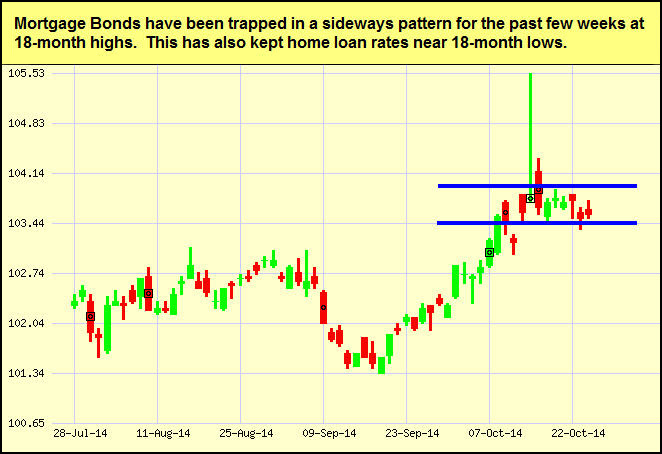
Remember: Weak economic news normally causes money to flow out of Stocks and into Bonds, helping Bonds and home loan rates improve, while strong economic news normally has the opposite result. The chart below shows Mortgage Backed Securities (MBS), which are the type of Bond on which home loan rates are based.

When you see these Bond prices moving higher, it means home loan rates are improving—and when they are moving lower, home loan rates are getting worse.

To go one step further—a red "candle" means that MBS worsened during the day, while a green "candle" means MBS improved during the day. Depending on how dramatic the changes were on any given day, this can cause rate changes throughout the day, as well as on the rate sheets we start with each morning.

As you can see in the chart below, Mortgage Bonds remain near 18-month highs, helping home loan rates reach 18-month lows. I'll continue to monitor them closely.
Chart: Fannie Mae 3.5% Mortgage Bond (Friday Oct 24, 2014)
Japanese Candlestick Chart


The Mortgage Market Guide View...
3 Steps to Becoming an Expert

Peter Economy, management expert and co-author of the bestselling book, "Managing for Dummies," says the secret to being more valuable at your job, revitalizing your career, or getting paid more is simple—become an expert. He recommends the following three steps to get there:

Step 1. Understand what you're interested in. What you already know can put you within short reach of being an expert in your field (if you aren't one already). This is the least time-intensive route. But if what you're already doing no longer interests you, you must find something inspiring enough to make learning feel effortless.

Step 2. Focus on one thing at a time. Learn too many things at once and you'll be overwhelmed and probably fail. Don't move on to the next subject of your expertise until you feel comfortable with the one you're working on now.

Step 3. Practice makes perfect. There's no such thing as an overnight expert. Be willing to invest the time for:
  • Studying. Reading, taking courses, attending training or seminars, watching videos, hiring a mentor, and learning from other experts are all great avenues.
  • Applying. Getting practical experience will help you go deeper, work out the kinks, and fully explore your field of expertise.
  • Presenting. Documenting your findings with a journal or blog will help you understand even more facets of your expertise. If at all possible, write or speak about your trials and resolutions, teaching others about your journey.
Please feel free to pass these tips along to your team, clients and colleagues.

Source: Inc.com


Economic Calendar for the Week of October 27 - October 31
Date
ET
Economic Report
For
Estimate
Actual
Prior
Impact
Mon. October 27
10:00
Pending Home Sales
Sep
NA

-1.0%
Moderate
Tue. October 28
08:30
Durable Goods Orders
Sep
NA

-18.4%
Moderate
Tue. October 28
09:00
S&P/Case-Shiller Home Price Index
Aug
NA

6.7%
Moderate
Tue. October 28
10:00
Consumer Confidence
Oct
NA

86.0
Moderate
Wed. October 29
02:00
FOMC Meeting
Oct
NA

0.25%
HIGH
Thu. October 30
08:30
GDP Chain Deflator
Q3
NA

2.1%
Moderate
Thu. October 30
08:30
Gross Domestic Product (GDP)
Q3
NA

4.6%
Moderate
Thu. October 30
08:30
Jobless Claims (Initial)
10/25
NA

283K
Moderate
Fri. October 31
09:45
Chicago PMI
Oct
NA

60.5
HIGH
Fri. October 31
10:00
Consumer Sentiment Index (UoM)
Oct
NA

86.4
Moderate
Fri. October 31
08:30
Personal Income
Sep
NA

0.3%
Moderate
Fri. October 31
08:30
Personal Spending
Sep
NA

0.5%
Moderate
Fri. October 31
08:30
Personal Consumption Expenditures and Core PCE
Sep
NA

0.1%
HIGH
Fri. October 31