Showing posts with label 1st Time Home Buyer. Show all posts

Wednesday, April 1, 2015

Chesapeake Homes: Another Voice Heard from: Time to Buy


Keeping Current Matters
Speaks!

As I just posted yesterday, it could be a big mistake not to buy a home in 2015.  I had discussed the key factors for making that home purchase now:

   1.  Low low interest rates
   
   2.  Much Improve Mortgage Availability

   3.   Home prices rising

You will see that this highly respected Real Estate resource backs up my thoughts on a national level.  I was specifically addressing the Chesapeake Real Estate Market and that of Hampton Roads in general. 

If after reading this blog, call me!!  I know you will be ready to go!
757 580-6546.


Tuesday, January 13, 2015

New Lower FHA Premium


GREAT NEWS
for 1st Time Home Owners
and Investors

FHA has just announced new lower mortgage insurance premiums.   This is the best news for many 1st time home owners and investors that frequently seek low down payment loans.

The change may seem small to some but the simple change from 1.07% to .85% really saves a home buyer good money.

As so elegantly stated in the attached handout, a buyer can save almost $30,000 on a $200,000 mortgage over the life of the loan.  That's not chicken feed(unless your feeding one huge flock of chicken!).

Home buyers take a look at this handout.  Then call your Realtor!!!


Monday, December 8, 2014

Best Deduction Around: Mortgage Deduction


Save on Taxes
with
Mortgage Interest Tax Deduction

Whenever conferring with a 1st time home buyer, I always discuss the significant advantages of home ownership over renting.  Not only is there the significant pride and value of home ownership itself, there is all the financial benefits that arise from improved credit worthiness, opportunity for increasing equity and ability to tactfully upgrade/enhance the property to increase the home's value.

Yet, the greatest benefit may be the Mortgage Interest tax deduction.  Itemize your taxes and suddenly you can deduct all the interest paid on your mortgage.   As a result, you get a significant reduction of taxes owed just for the fact you own a home.  Try to get the landlord to give you a fat rebate for living in a rental for a year!

Read below as Al Clark spells out the details!  No use restating!!

Be sure to read and use the information!  If still a tenant, read and then call me and we will ensure you can deduct in 2015!


Homeowner Tax Tips For Your Best Return: Deducting Mortgage Interest


The mortgage interest deduction is one of the largest tax benefits homeowners get. Here’s what you need to know to take advantage of it:
If you itemize your deductions on Schedule A of Form 1040, you can include the interest you paid on your home mortgage of up to $1 million ($500,000 for married, filing single) as long as you used the loan to buy, build or improve your home.
You can generally deduct the interest on a home equity loan of up to $100,000 ($50,000 for married filing single) used for any purpose, as long as the home equity debt plus your first mortgage don't add up to more than the value of your home.
Get more details about the Mortgage Interest Deduction in Internal Revenue Service Publication 936.
Here are 10 more things you need to know to claim your mortgage interest deduction:
  1. In general, you have to be legally obligated to pay the mortgage. In other words, you can’t deduct mortgage interest paid, for example, on your parents' home unless you have a legal duty to pay their mortgage.
  2. If you have a high income, the Alternative Minimum Tax can affect your ability to deduct mortgage interest.
  3. Your mortgage must be a secured debt, meaning your lender can foreclose on your home if you don’t pay your mortgage.
  4. Your home can be a boat, mobile home, house trailer, condominium, cooperative or similar property, which has cooking, sleeping and toilet facilities.
  5. You can deduct late payment charges as though they were interest as long as your lender didn't perform a specific service in exchange for the fee.
  6. If you pay off your home mortgage early and you have to pay a prepayment penalty, that amount also counts as interest, as long as your lender doesn't charge the fee in exchange for a specific service performed or to cover the cost of something connected to your mortgage (like giving you a payoff statement).
  7. If you make annual, or periodic, rental payments on a redeemable ground rent, you can generally deduct them as mortgage interest. Payments made to end the ground lease, and payments for nonredeemable ground rent, aren't deductible as mortgage interest.
  8. Reverse mortgage interest generally isn't deductible until it’s paid – and you don’t usually pay interest on a reverse mortgage until you (or your heirs) sell your home and pay off the reverse loan.
  9. If you own a cooperative apartment, you’ll get a Form 1098 from the co-op telling you how much interest you paid on any building-wide mortgages. You can deduct that amount along with the interest you paid on your individual unit loan (if you got a mortgage to buy your shares in the co-op).
  10. The rules change if you got your mortgage on or before Oct. 13, 1987.
Getting a headache from thinking about all the different rules? You can use tax software or an online tax service to prepare your return. PC Magazine says the TaxACT Ultimate Bundle was the best online tax program last year. Consumer Reports Magazine has good advice about selecting online tax preparation help.


Monday, October 27, 2014

How Much Longer Can Historic Low Rates Last???????????

Interest Rates
The Unbelievable Phenom

Since 2005, interest rates have been below the historical 7% good rate.  Except for the past 9, going on 10 years, a 7% rate was always the rate to buy a home.  Many times rates have be 8-10% with periods in the 14-18% range.

Thus, interest are an absolute Phenom to buyers and sellers.  Last two weeks, as shared in Jim's MMG Weekly below, interest rates have been below 4% for a well financed buyers.  Yet even a buyer with "a lesser financial profile" would still see a rate just over 4%.

No doubt the economy's slow recovery and the stock market recent stock fluctuations has kept investors in the safe haven of government and other bonds.   Jim again explains the indirect but effective relations between these two factors.

Yet, if you are still sitting on the sideline wondering if it is a good time to move, you have to be wondering when with this ride end.
Sure if you miss this rate and buy when rates have "zoomed up" to 5%, you will still have an interest rate rarely seen(except for the past 9-10 years and back in the 50s).

Keep up with this blog and you will know when the trend is turning!
But do you really want to wait??


Provided to you Exclusively by Jim Belote  
For the week of Oct 27, 2014 | Vol. 12, Issue 43
Jim Belote
Jim Belote
Branch Manager, MBA
Union Mortgage Group
Phone: (757) 395-LOAN
Fax: (757) 351-6471
E-Mail: jim@jimbelote.com
Union Mortgage Group
582 Lynnhaven Parkway, Suite 300
Virginia Beach, VA 23452
In This Issue...
Last Week in Review: Home loan rates remain near 18-month lows, while housing reports showed mixed news for the sector.

Forecast for the Week: Look for key reports on housing, consumer attitudes, U.S. economic growth, inflation and more. Plus, a big Fed meeting is ahead.

View: Check out the secret to being more valuable at your job, revitalizing your career, or getting paid more.
Last Week in Review
It's been said that "opportunity comes knocking." And that's certainly the case for people looking to purchase or refinance a home, as home loan rates remain near 18-month lows.
In recent weeks, investors have moved into the safe haven of the Bond markets for several reasons, including weak economic data here at home, concerns about Ebola, and economic and geopolitical uncertainty overseas. This has helped Mortgage Bonds reach 18-month highs, and since home loan rates are tied to Mortgage Bonds, rates have reached 18-month lows.

In addition, Stocks have been volatile due to the upcoming end of the Fed's Bond-buying program. The Fed has been slowly tapering its purchases throughout the year, and every indication is that the Fed will completely end the program at its meeting on October 28 to 29. The key takeaway is that Stocks performed terribly after the first and second rounds of the Fed's Bond-buying program ended. If Stocks worsen, Mortgage Bonds and home loan rates could continue to improve.

In other news, key housing reports showed mixed results for the sector. September Existing Home Sales reached its highest pace of the year, showing gains in all major regions except for the Midwest. September New Home Sales also reached a six-year high. However, New Home Sales for August, which were originally reported at 504,000, were revised to 466,000. Sales in June and July were also revised lower.

The bottom line is that home loan rates remain near some of their best levels of the year, and now is a great time to consider a home purchase or refinance. Let me know if I can answer any questions at all for you or your clients.
Forecast for the Week
A packed economic calendar is in store this week. Plus, the Fed meeting could cause volatility in the markets.
  • Housing news kicks off the week with Pending Home Sales on Monday, followed by the S&P/Case Shiller Home Price Indexon Tuesday.
  • Durable Goods Orders will also be released on Tuesday.
  • We'll get a read on how consumers are feeling with Consumer Confidence on Tuesday and the Consumer Sentiment Index on Friday.
  • Thursday's reports feature Weekly Initial Jobless Claims and the first reading on Q3 Gross Domestic Product.
  • Friday brings Personal Income, Personal Spending, Personal Consumption Expenditures (inflation index), theEmployment Cost Index, and Chicago PMI (a regional manufacturing report).
In addition, the Fed's next two-day meeting of the Federal Open Market Committee begins Tuesday, with the Monetary Policy Statement being released on Wednesday. Investors will be watching closely to see if the Fed fully tapers its ongoing Bond-buying program. This announcement has the potential to create volatility in the markets.

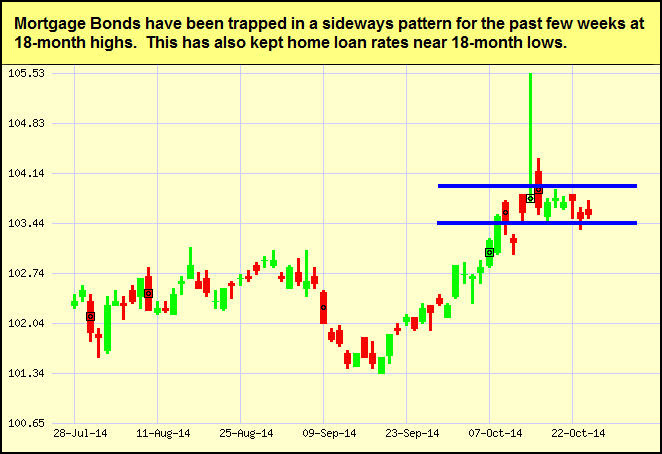
Remember: Weak economic news normally causes money to flow out of Stocks and into Bonds, helping Bonds and home loan rates improve, while strong economic news normally has the opposite result. The chart below shows Mortgage Backed Securities (MBS), which are the type of Bond on which home loan rates are based.

When you see these Bond prices moving higher, it means home loan rates are improving—and when they are moving lower, home loan rates are getting worse.

To go one step further—a red "candle" means that MBS worsened during the day, while a green "candle" means MBS improved during the day. Depending on how dramatic the changes were on any given day, this can cause rate changes throughout the day, as well as on the rate sheets we start with each morning.

As you can see in the chart below, Mortgage Bonds remain near 18-month highs, helping home loan rates reach 18-month lows. I'll continue to monitor them closely.
Chart: Fannie Mae 3.5% Mortgage Bond (Friday Oct 24, 2014)
Japanese Candlestick Chart


The Mortgage Market Guide View...
3 Steps to Becoming an Expert

Peter Economy, management expert and co-author of the bestselling book, "Managing for Dummies," says the secret to being more valuable at your job, revitalizing your career, or getting paid more is simple—become an expert. He recommends the following three steps to get there:

Step 1. Understand what you're interested in. What you already know can put you within short reach of being an expert in your field (if you aren't one already). This is the least time-intensive route. But if what you're already doing no longer interests you, you must find something inspiring enough to make learning feel effortless.

Step 2. Focus on one thing at a time. Learn too many things at once and you'll be overwhelmed and probably fail. Don't move on to the next subject of your expertise until you feel comfortable with the one you're working on now.

Step 3. Practice makes perfect. There's no such thing as an overnight expert. Be willing to invest the time for:
  • Studying. Reading, taking courses, attending training or seminars, watching videos, hiring a mentor, and learning from other experts are all great avenues.
  • Applying. Getting practical experience will help you go deeper, work out the kinks, and fully explore your field of expertise.
  • Presenting. Documenting your findings with a journal or blog will help you understand even more facets of your expertise. If at all possible, write or speak about your trials and resolutions, teaching others about your journey.
Please feel free to pass these tips along to your team, clients and colleagues.

Source: Inc.com


Economic Calendar for the Week of October 27 - October 31
Date
ET
Economic Report
For
Estimate
Actual
Prior
Impact
Mon. October 27
10:00
Pending Home Sales
Sep
NA

-1.0%
Moderate
Tue. October 28
08:30
Durable Goods Orders
Sep
NA

-18.4%
Moderate
Tue. October 28
09:00
S&P/Case-Shiller Home Price Index
Aug
NA

6.7%
Moderate
Tue. October 28
10:00
Consumer Confidence
Oct
NA

86.0
Moderate
Wed. October 29
02:00
FOMC Meeting
Oct
NA

0.25%
HIGH
Thu. October 30
08:30
GDP Chain Deflator
Q3
NA

2.1%
Moderate
Thu. October 30
08:30
Gross Domestic Product (GDP)
Q3
NA

4.6%
Moderate
Thu. October 30
08:30
Jobless Claims (Initial)
10/25
NA

283K
Moderate
Fri. October 31
09:45
Chicago PMI
Oct
NA

60.5
HIGH
Fri. October 31
10:00
Consumer Sentiment Index (UoM)
Oct
NA

86.4
Moderate
Fri. October 31
08:30
Personal Income
Sep
NA

0.3%
Moderate
Fri. October 31
08:30
Personal Spending
Sep
NA

0.5%
Moderate
Fri. October 31
08:30
Personal Consumption Expenditures and Core PCE
Sep
NA

0.1%
HIGH
Fri. October 31

Wednesday, October 1, 2014

Twenty Four Reason To Call A Realtor


Why Call A
Realtor??

A Realtor is more that a resource for ethical, knowledgeable, experienced service to purchase a home or investment or to sell a piece of real estate that you may own.

A Realtor is an endless source of information!  With many contacts in the city(s) that he/she works and being very familiar with attributes of these locations, a Realtor knows more than one might think!   And what he or she doesn't know, they will find out!!!

Here are a quick 24 reasons to call, message, email, text, tweet a Realtor:

  1. Need a contractor to do repairs/get estimate

  2. Seek a job in a new town

  3. Need temporary housing in a new location

  4. Need Vacation rentals for visiting family

  5. Seek Daycare options: Kids, Elders, Pets

  6.  Need House Cleaner/Carpet Cleaner

  7.  Need to Refinance: Rates, Advantages, Mortgage Officers

  8.  Need quality Pest and Termite company

  9.  Seek restaurant to entertain visiting family

10.  Questions on Property Owner Association or Condo
          Association to which you belong

11.   Landlord rights and obligations

12.   Tenants rights and obligations

13.  Need Information on School zone

14.  Need Information on Schools in area: music programs
           test scores, special education, after school options, etc

15.  Holiday Events/Parades

16.  Need to compare the cost of renting vs buying a home   

17.  Want to know key differences/benefits of living in various
           cities in given area

18.  Need present home's value

19.  Need to verify information on Zillow, Truila or another real 
          estate web site

20.  Have co-worker, neighbor or friend seeking a new home

21.  Have co-worker, neighbor or friend seeking to sell property

22.  Seek available homes for your growing or changing family

23.  Questions on what to do to prepare to sell

24.  Questions on steps to/how to go about buying a house

And this is only the beginning!!

For example, you could ask me where the nearest Dairy Queen is to you in Hampton Roads,  I could help you out.  You would be surprise what we know!!

We get around!

Wednesday, August 27, 2014

Top Five Reasons to Buy! Real Estate News Article


Time to Buy!!

It isn't a fire sale!!! Yet if a bit of red print can light a fire under all you who are pay too much in rent or feeling claustrophobic in a home meant for three with four kids and two adults, red print it will be.

With school starting in most parts of the country already and beginning in the Northeast after Labor Day, many would be buyers that have sat on the sidelines wondering "if now is the time to buy" may just sit it out to Spring 2015.

Yet, as I have noted with a recent post on home prices, there is really no reason for a buyer to fear the home that he/she buys will be worth less tomorrow that today due to a coming housing bubble burst.   Values are no where near they were when the housing bubble burst in 2008/2009. 

Though I have discussed all these points in prior blogs recently, Realtor.com posted this article from Real Estate News.  It summarize why YOU should buy today!!

(If you need to sell, these are also the reasons to sell!)

Read and then call a Realtor!! If in Hampton Roads, call me! You will be happy you did: 757 580-6546.

Top 5 Reasons to Buy a House Right Now

Top 5 Reasons to Buy a House Right Now photoBuying a house is a highly individual decision—and a local one—but current trends are creating a favorable situation for many would-be homeowners.
Interest rates are low, employment is rising, home prices—in most markets—are still well below their peaks, and rents are through the roof.
Every family and each individual has various factors affecting the ability and the decision to buy a home. If you live in a market where studio apartments are $2,400 per month—while nearby condos sell for $300,000—it might make sense to buy a house instead.
(Remember, a local REALTOR® always is your best resource in helping you assess market conditions.)

Five Compelling Reasons to Buy a House Right Now

1. Interest Rates Are Still Low
Mortgage interest rates are still low—for now.
A 30-year-fixed-rate loan now averages 4.16%, according to Freddie Mac, but many economists believe we will see 5% rates next year. As interest rates increase, so do your monthly payments.
A $300,000 house at 4.16% with 20% down would have a monthly payment of $1,168. With a 5% interest rate, that payment increases to $1,288.
2. There’s More Inventory
As more houses enter the for sale market, prices stabilize.
“Inventories are at their highest level in over a year, and price gains have slowed to much more welcoming levels,” said Lawrence Yun, Chief Economist at the National Association of REALTORS®.
The upside is consumers now have more choices, if they are looking at existing homes.
New homes are another story: Yun says new construction needs to double its current production to meet market demand.
3. Home Prices Are Going Up
Home prices are rising.
The median price of an existing home was $223,300 in June, or 4.3% higher than June 2013. That’s the 28th consecutive month of year-over-year price gains, and economists expect that trend to continue. However, we are still at least 20% off the peak prices of 2006.
“Attempting to buy a home when the market is at its lowest point—or to sell at the peak—is tricky,” said Jonathan Smoke, Chief Economist for realtor.com®.
He compares it to trying to time the stock market.
“You might get lucky one or two times, but overall, timing the market does not work,” Smoke added. “It all points to purchasing power, and that’s a reflection of price and interest rates, which will both be higher in the future.”
4. Rents Are Sky-High
If you live in a big city, then you know rent is astronomical. In San Francisco, many people are spending 42% of their monthly income to pay the rent. Nationwide, rents are rising at a 4% annual clip.
It’s not unusual to see adults rooming together in expensive cities like New York, San Francisco and Chicago, but everyone needs his or her own space at some point.
Buying a home would lock in your monthly payment and stabilize your finances with a fixed-rate mortgage. This is, of course, assuming you don’t live the San Francisco area, where the average price of a home is $1 million.
(If you’re renting and never thought you could afford to buy a house, try our Rent vs. Buy calculator to see what’s possible.)
5. Employment on the Rise
Perhaps nothing is as important to the financial stability you need to buy a home as steady employment. The U.S. economy is finally adding jobs—about 200,000 new jobs per month.
The next generation of home buyers—the Millennials—has been particularly affected by the nation’s job slump. Saddled with student loans and tight lending restrictions, many in this generation have been living with their parents to save money until the economy picks up.
If your employment prospects look good these days and the other four factors check out, then it may indeed be the right time for you to buy a home of your own.