Showing posts with label New Homes. Show all posts

Tuesday, June 17, 2014

U.S. Census Bureau: Characteristics of New Homes


                                   New Homes 

Great Report!!!  Were you wondering what was happening in new homes?

Here is a U.S. Census Bureau recap of the key factors in new homes.   A really great read if you are thinking about buying or selling a home.

It shares what the buyers are looking for in the "structural aspects" of the home.

Highlights

Highlights of Annual 2013 Characteristics of New Housing


Of the 569,000 single-family homes completed in 2013:
  • 518,000 had air-conditioning.
  • 59,000 had two or fewer bedrooms and 251,000 had four bedrooms or more.
  • 27,000 had one and one-half bathrooms or less, whereas 188,000 homes had three or more bathrooms.
  • 166,000 had a full or partial basement, while 91,000 had a crawl space, and 312,000 had a slab or other type of foundation.
  • 305,000 had two or more stories.
  • 333,000 had a forced-air furnace and 216,000 had a heat pump as the primary heating system.
  • 347,000 had a heating system powered by gas and 214,000 had a heating system powered by electricity.
The average single-family house completed was 2,598 square feet.

Of the 307,000 multifamily units started in 2013, 23,000 were age-restricted.

Of the 195,000 multifamily units completed in 2013:
  • 14,000 were age-restricted.
  • 129,000 were heated with electricity and 64,000 were heated with gas.
  • 91,000 had two or more bathrooms.
  • 79,000 had one bedroom and 27,000 had three or more bedrooms.
The average square footage of multifamily units built for rent was 1,082.

Of the 10,000 multifamily buildings completed in 2013:
  • 5,000 had one or two floors.
  • 6,000 used electricity as the primary heating fuel.

Of the 429,000 single-family homes sold in 2013:
  • 120,000 used vinyl siding as the principle type of exterior wall material, while only 12,000 used wood.
  • 300,000 had 2-car garages, whereas 98,000 had garages for three cars or more.
  • 207,000 had one fireplace and 20,000 had two or more fireplaces.
The average sales price of new single-family homes sold was $324,500, compared with the average price of $292,200 in 2012.
The average price per square foot for new single-family homes sold was $93.70.
The average new single-family home sold was built on a lot of 15,456 square feet.

91,000 contractor-built single-family homes were started in 2013.
The average contract price was $298,000.


Note: the estimates shown here are based on sample surveys and are subject to sampling variability as well as nonsampling error.

Monday, July 29, 2013

Good News!!! Self Employed Can Get Mortgages


Good New is always pleasant to hear.  Especially true when the good news fits your situation.  As a Realtor, I am self-employed as are many in other fields of accounting, financial services, electricians, plumbers, ect.   Hearing that mortgage have opened to this group of buyers is another positive sign that the housing market has recovered and that the banks are helping the process.

The only item misconstrued a bit in Jim's Mortgage Matters is the June sales being a bit lower than May.   Though a bit unusual as these two months do run very similar and very strong, the continuing issue hurting resale homes is the lack of inventory.  Though we have fewer distressed homes, we also have, especially in lower price ranges, a shortage of inventory. 

Multiple offers are back!!  The shortage of inventory is causing buyers to need to out compete another buyer for a home.

We will begin to beat the numbers on the sales side when the inventory strengthens.

If you are in Hampton Roads, call me or reply to this post as you can sell your home if it is time to move!


Keeping you updated on the market! For the week of 
July 29, 2013

MARKET RECAP
More of the Same With Mortgage Rates
For the past couple weeks, we've been speculating that mortgage rates have likely plateaued and were unlikely to push much higher. Our rationale was similar to that of many market participants: The threat of the Federal Reserve tapering from quantitative easing (money pumping and low interest rates) was overstated.
A meaningful spike or dip in rates could be in waiting next Friday with the release of the July employment report. Job growth significantly higher than the consensus estimate could lead to a rate spike; disappointing job growth will likely drop rates (though nowhere near to the March lows).
Job growth, a benefit of economic growth, means housing will continue to improve, even if interest rates rise. Job growth (and to a lesser extent wage growth) is key: More people working means more people who can afford a home and financing costs.
For now, though, housing looks good. We say that even though sales of existing homes came in below expectations for June. The good news is market composition is healthier. Only 15% of sales were related to distressed properties – the lowest reading since the number was tracked in 2008. At the same time, the market is shifting more toward owner-occupied buyers and away from investors, who comprised only 17% of purchases for June.
Prices also continue to trend higher. The national median price for an existing home rose a strong 5.5%, lifting the national number to $214,200. Rising prices, in turn, will further lift inventory, which remains tight and is limiting sales in many local markets.
As for new homes, they're moving in the opposite direction: sales are up, but prices are down.
New home sales, at 497,000 units on an annualized rate, handily beat the consensus estimate for 481,000 units. The pace of new-home sales is on a strong two-year run, and is approaching levels unseen since 2008. We were equally encouraged to see that sales maintained their strength in May and June despite the spike in mortgage rates.
It's possible that new home sales maintained their momentum on price discounting. For June, the national median price of a new home was down 5% to $249,700. Year over year, though, the price trend remains up, with year-over-years gains approaching 10%. Given that supply remains tight, at 3.9 months supply at the current sales rate, homebuilders should be able to maintain pricing power into the foreseeable future.

Economic
Indicator
Release
Date and Time
Consensus
Estimate
Analysis
Pending Home Sales Index
(June)
Mon., July 29,
10:00 am, ET
5.0%
(Increase)
Important. Underlying economic strength should lead to sales gains over the next few months.
Mortgage Applications
Wed., July 31,
7:00 am, ET
None
Important. Purchase applications need to gain momentum to support home-sales and price gains.
Federal Reserve
FOMC Meeting Announcement
Wed., July 31,
2:00 pm, ET
None
Important. Dissent on quantitative has risen in recent months. Further dissent will pressure interest rates to rise.
Construction Spending
(June)
Thurs., Aug. 1,
10:00 am, ET
6.0%
(Increase)
Important. Gains in residential construction spending is a plus for economic growth.
Employment Situation
(July)
Fri., Aug. 2,
8:30 am, ET
Unemployment Rate: 7.5%
Payrolls:188,000 (Increase)
Very Important. Monthly payroll gains averaging close to 200,000 will push the Federal Reserve to taper quantitative easing.

Flexibility is Becoming the New Norm
One of the more recurring laments over the past few years has centered on tight, rigid lending. We've all known someone who should have received financing, but didn't because lenders were too risk averse.
One upside of an improving market is a willingness to accept more risk, and we are seeing more risk acceptance in the mortgage market. Down payment requirements are easing, while fewer borrowers are being turned down on credit scores alone.
Piggyback loans have also resurfaced, as have stated-income loans. On the latter, far too many self-employed people have been excluded from the mortgage market. Fortunately, that's changing, which means more people are added to the pool of home sellers and buyers. More participants lead to more robust and more stable markets.
Even subprime loans are coming back to serve a market of borrowers who have healthy incomes but who suffered a short sale or credit hit when the market imploded in 2008 and 2009.
To be sure, we all want a more accommodating mortgage-lending market. The good news is we are making progress in that direction.


EQUAL HOUSING LENDER

Thursday, April 25, 2013

PilotOnline: New Home Construction Rebounds

This Pilot article is a great read!

Only more support to the every growing crescendo noting an improving housing market.
We can't help but shout it as Realtors!

Off the Fence!!! 

Hampton Roads construction biz rebounding slowly

Posted to: Business Jobs

Michelle Muglia’s trio of Chesapeake-basedconstruction companies employed 90 workers at the height of the housing boom, but by the time the dust settled after the Great Recession, all but 36 were out of a job.
“It was really the ugliest time in our lives,” said Muglia, who co-founded drywall, painting andflooring companies with Rob LeBlond about 15 years ago. “My partner and I had to bring great people in and say, ‘I’m sorry, but we have to reduce overhead.’ ”
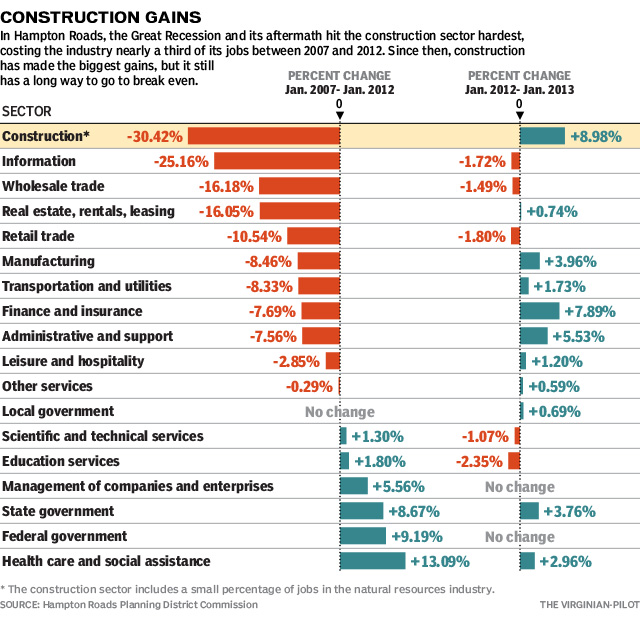
Construction was the hardest-hit employment sector in Hampton Roads between January 2007 and January 2012, losing 14,600 of its 48,000 jobs – 30 percent – according to data from the Hampton Roads Planning District Commission.
By January 2013, the industry had regained 3,000 jobs and was leading job growth locally with a nearly 9 percent boost over January 2012.
But a long road lies ahead as construction companies limp out of a rut. Many are still feeling squeezed by a contracted economy and the uncertainty over looming defense cuts.
 
Muglia said she’s not surprised to see data pointing to a turnaround in her industry.
She and LeBlond were able to hire back some of the employees they laid off after the housing bust. Collectively, Tidewater Interior Wall & Ceiling Inc., Mid-Atlantic Painting Inc. and Rated Floor Systems of Virginia LLC now employ 55 workers, 19 more than when the businesses bottomed out.
“Last year, our sales were just on fire,” Muglia said. “Literally, it was like the banks released money on the same day, because all of a sudden,the jobs started again.”
Apartment complex construction and renovation have generated most of the contracts in the past year, Muglia said.
Revenue at the peak was around $18 million for the three companies, she said. That dropped to less than $10 million after the bust, but it climbed back to a little over $16 million in 2012.
If Muglia could charge 2006 or 2007 rates for work, revenue would have topped $20 million last year, but owners of several construction companies said they had to slash prices to stay in business.
Mark Worton, owner of Landstar Paving in Chesapeake, said many of his former cohorts sold their equipment and found work in other industries.
Landstar specializes in repairing parking lots and driveways. The pace of business has been relatively level, Worton said, but his profits have been ravaged by high gas prices.
He used to employ six part-time workers, but that’s dropped to two or three. He doesn’t expect to be able to hire anytime soon.
“That makes me get out and do all the work,” Worton said. “I didn’t have to do that in the past. … But I feel like I’m succeeding because I’m still in business.”
Kenneth Carpenter, a Suffolk-based land surveyor who works mainly in new-home construction, feels the same way. He used to have a crew of five or six workers, but now he and his wife are on their own.
In 1999, his company, Kenneth R. Carpenter Land Surveyor PC, landed 272 new contracts. Work dipped significantly in 2002 but had inched back up to 108 contracts by 2007.
Then the bottom fell out and homebuilding nearly ground to a halt. Carpenter had 49 new contracts in 2008, 31 in 2010 and 23 in 2012.
“Things just seem like they’re the next thing to dead,” he said. “They’re just not moving.”
Carpenter wonders whether he was aggressive enough in going after business, but he knows anecdotally that his fellow surveyors have suffered, too.
Greg Grootendorst, chief economist for the Planning District Commission, said it’s not clear from data which specialties in the construction industry are rebounding and which are still struggling, but that the sector is no longer a drag on the local economy.
If growth continued at the 2012 pace for the next four years, employment might return to pre-recession levels, Grootendorst said. But military cuts resulting from sequestration have dampened expectations. Nearly half of the local economy is dependent on defense spending.
“We have, in the region, a lot of making up to do with respect to employment,” Grootendorst said. “Ideally, what we’d like to see is every industry headed toward recovery, but, unfortunately, that’s not what we’re realizing at this point.”
Total nonfarm employment in Hampton Roads dropped 5.2 percent between January 2007 and January 2011. But since then, it has grown 2.6 percent, to 737,200 jobs.
In a Planning District Commission breakdown of 32 local employment sectors, construction was among eight that had fewer employees in 2012 than in 1990.
Nationally, construction employment grew from September through February, but it held steady in March, according to an employment study of seasonally adjusted private sector jobs published recently by ADP. Local figures for March are not yet available from the U.S. Bureau of Labor Statistics.
Homebuilder Ben Braddock, who owns Norfolk-based Rock Creek Development, said his company went from building eight to 10 homes a year during the heyday to two to three homes a year.
Business is still slow, and he doubts it will return to pre-recession levels because young adults are tending to rent rather than buy new homes.
“There’s a whole lot of new apartments, and the rental market in Hampton Roads is doing well because there’s a whole lot more folks out there that are going to be renting for a while because either they got burned by their first home or they got stuck in their first home,” Braddock said.
Clancy and Theys, a national construction company with an office in Newport News, has benefited from the apartment boom. Thomas O’Grady, director of business development for the Virginia division of the company, said multifamily construction has been the strongest sector of commercial construction.
But Clancy and Theys has a pipeline full of jobs in higher education, health care and government work, O’Grady said.
This year, the company is far more optimistic about the future, but there are still uncertainties, he said.
“I’m not sure we’ll ever go back to those go-go years,” O’Grady said.
Sarah Kleiner Varble, 757-446-2318, sarah.varble@pilotonline.com
http://media.hamptonroads.com/cache/files/images/1064781000.jpg